Modern basketball offense is no longer evaluated just by whether a play looked smooth or whether the ball dropped through the net. Today, elite teams blend coaching intuition, film study, and data to answer a much simpler, deeper question: how much value did that possession actually generate?
That shift marks the real divide between traditional coaching and modern analytics. Data isn’t here to replace a coach’s eye—it’s here to sharpen it. It helps staff and players separate execution from pure luck, accurately rate shot quality, and build offensive habits that hold up over a 82-game season.
The Traditional Approach: Execution and Execution Alone
For decades, offensive evaluation stayed strictly on the surface:
- Did we set a solid screen and hit the right angle?
- Was the spacing correct?
- Did the ball-handler read the drop coverage properly?
- Did the possession finish with an open shot?
These remain fundamental. If your team can’t set proper screens, pass on time, or clear out space, no formula on earth will save your offense. Film study has always centered on whether the team ran the play as designed.
The catch? Traditional eyes often fall into the result trap.
A terrible, contested fadeaway that goes in gets a quiet pass, while a brilliant drive-and-kick that leads to a missed wide-open corner three gets a reaction. Evaluating possessions purely on execution leaves you vulnerable to randomness.
The Analytical View: Value Over Outcome
Analytics looks past the immediate result and asks a baseline question: What was the expected value of that sequence?
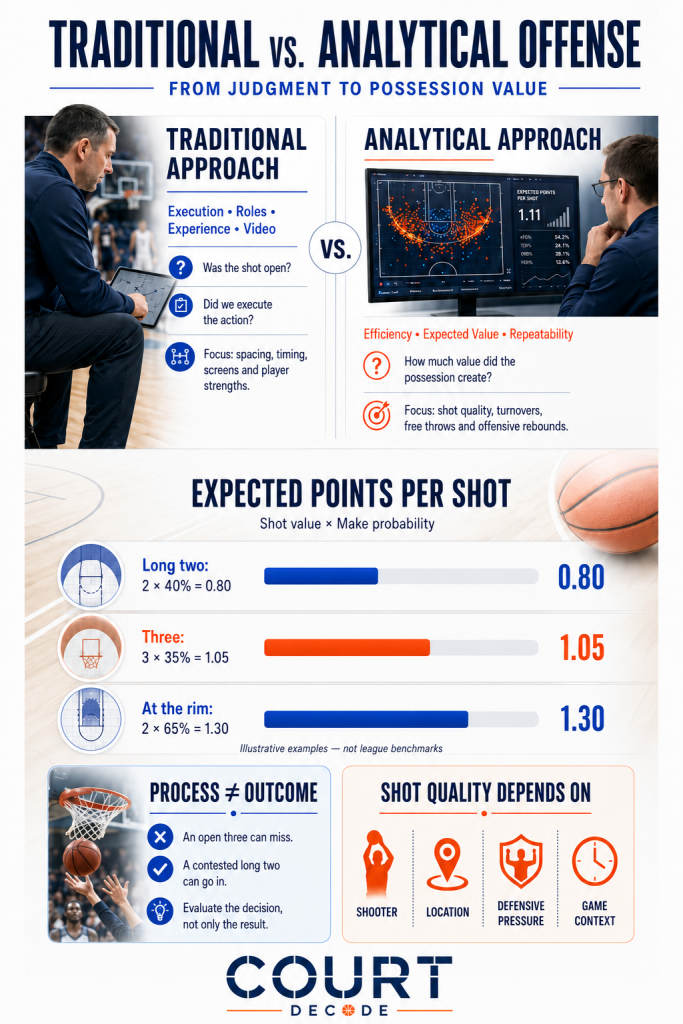
Instead of celebrating every made basket and lamenting every miss, the modern approach measures three things:
- Efficiency
- Expected Point Value
- Repeatability
Take three basic shot types:
- Long mid-range jumper: ~40% make rate = 0.80 Expected Points
- Above-the-break three: ~35% make rate = 1.05 Expected Points
- At-the-rim attempt: ~65% make rate = 1.30 Expected Points
These aren’t static league rules, but the logic is obvious. Shots at the rim carry massive value because finishing rates are high and fouls happen often. The three-pointer beats the long two simply because of the math—an extra point offsets a slightly lower shooting percentage. Mid-range looks still have a place in late-clock situations or in the hands of elite creators, but as a primary diet, they bleed efficiency.
That doesn’t mean the instruction is “shoot only threes.” The actual objective is to generate the highest-value look available for the right player in that exact moment.
Process vs. Outcome: Why Results Lie
The hardest mental hurdle in basketball is separating the quality of a decision from its immediate outcome.
Imagine two back-to-back possessions:
- You run a crisp pick-and-roll, collapse the paint, kick it out to a 40% shooter in the corner, and he misses.
- The next time down, a guard ignores the play, dribbles for 18 seconds, takes a contested pull-up over two hands, and banks it in.
If you judge by the scoreboard, possession #2 wins. If you judge by sustainable strategy, possession #1 is what wins games over time. Good analytics gives coaches the discipline to reward possession #1 and fix possession #2 regardless of whether the ball went in.
What Actually Dictates Shot Quality?
A “good shot” isn’t a one-size-fits-all label. True shot quality comes down to four interlocking variables:
- The Shooter: A wide-open corner three for your best spot-up threat is an elite possession. The exact same look for a non-shooter is a victory for the defense.
- Location: Paint touches and perimeter attempts carry innate mathematical advantages over contested 18-footers.
- Contest Level: Defender distance, recovery speed, and closing angle drastically shift shot probability.
- Clock & Context: A contested mid-range pull-up with 2 seconds on the shot clock is a great decision. Taking that same shot 4 seconds into the possession is a failure in process.
Looking at the Entire Possession
Shot selection gets all the attention, but possession value accounts for the whole picture. Three critical drivers often decide offense far more than jump-shooting clips:
- Turnovers: A turnover yields 0.00 expected points and usually triggers the opponent’s transition game.
- Free Throws: Drawing fouls turns empty possessions into high-efficiency points while putting opposing starters in trouble.
- Offensive Rebounds: Keeping a play alive resets the clock against a scrambled defense, drastically raising the value of that second-chance sequence.
A great possession might start with a baseline drive, feature a paint touch, force a help defender to rotate, lead to a hockey assist, and end in a foul or an open shot. The final box score only records the end product, but the chain reaction is what actually created the point value.
Data, Film, and Coaching: The Hybrid Model
Data tells you what happened and how much it was worth. Film shows you why it happened. Coaching determines how to fix or repeat it.
Analytics was never meant to replace traditional coaching—it’s an extra lens. When integrated correctly, it stops teams from reacting to short-term variance and keeps them focused on creating high-value, repeatable possessions night after night.