The cross screen is one of the most effective off-ball screening actions for creating scoring opportunities around the paint. It is simple in structure, but when executed with proper timing, screening angle, spacing, and passing accuracy, it can force the defense into difficult decisions.
Unlike an on-ball screen, where the screener directly interacts with the ball-handler, a cross screen usually takes place away from the basketball. One offensive player moves across the floor—often through the paint—to screen the defender of a teammate positioned on the opposite side.
The objective is straightforward: move a defender away from a preferred defensive position and create an advantage for another offensive player.
For coaches, the cross screen is also an excellent teaching action because it combines several fundamental offensive concepts: screening technique, cutting, timing, reading the defense, spacing, and passing.
What Is a Cross Screen?
A cross screen occurs when an offensive player cuts from one side of the floor toward the opposite side to set a screen for a teammate.
The action most commonly takes place around the paint or low-post area, where defenders have limited space to navigate screens.
The screen can help a post player establish deeper position, free a cutter near the basket, or create a defensive switch that produces a favorable matchup.
The important point is that the screen is not simply designed to create movement. It is designed to change the defensive relationship between two players.
A properly executed cross screen forces the defender to make an immediate decision:
- Fight over or around the screen.
- Go underneath the action.
- Switch assignments.
- Help temporarily and recover.
- Give up position near the basket.
Each defensive response can create a different offensive opportunity.
Example of a Cross Screen
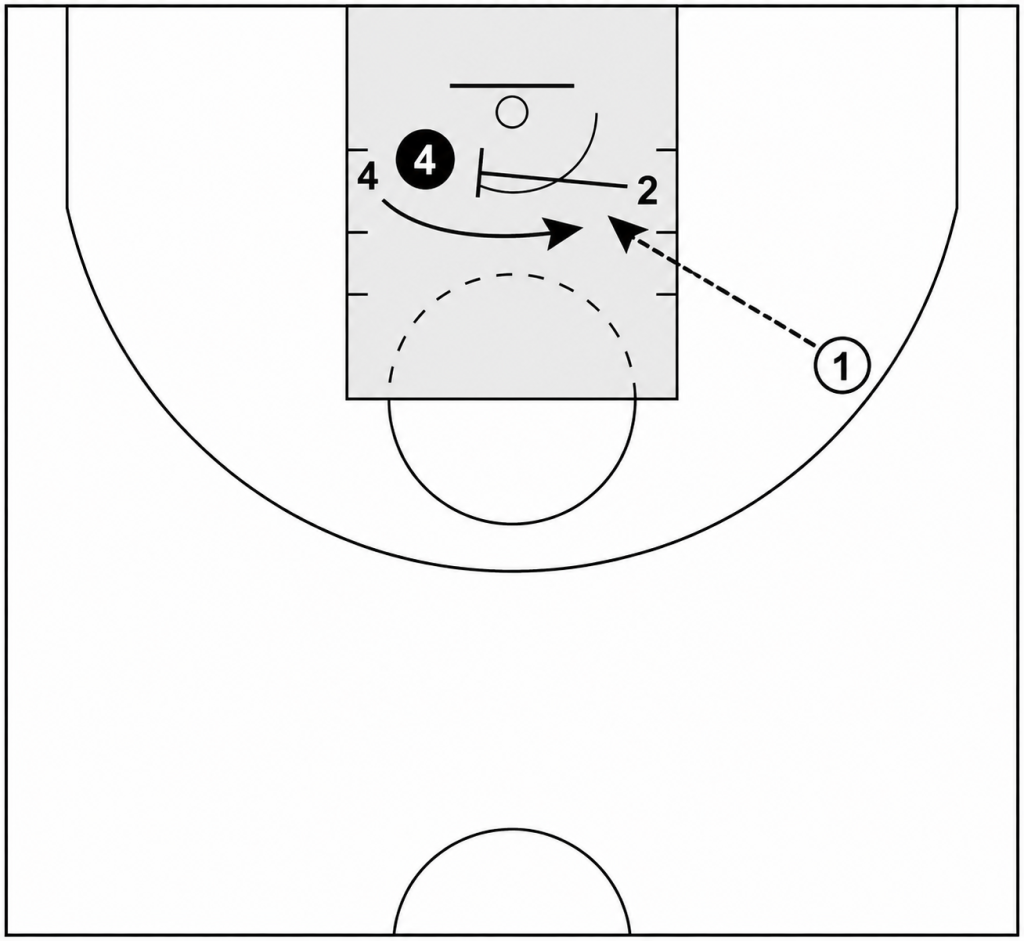
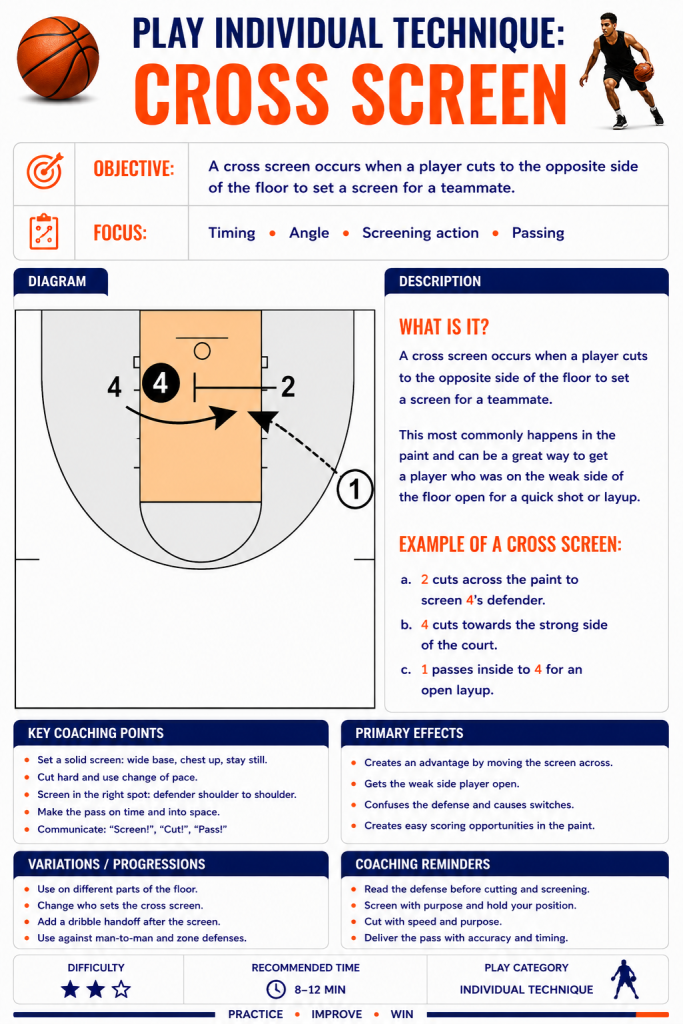
The infographic illustrates a simple three-player cross-screen action involving Players 1, 2, and 4.
The sequence is:
1. Player 2 cuts across the paint.
Player 2 moves toward Player 4 and positions the screen on Player 4’s defender.
The cut itself is important. Player 2 should move with purpose rather than slowly drifting toward the screening position. Good speed reduces the defender’s preparation time.
2. Player 2 screens Player 4’s defender.
The screener establishes a legal, balanced position and creates an obstacle between the defender and Player 4.
At the same time, Player 4 must read the screen and prepare to cut immediately.
3. Player 4 cuts toward the strong side.
Once the screen is established, Player 4 moves across the lane toward the ball side.
The objective is not simply to become open—it is to gain inside position and a direct scoring angle.
4. Player 1 delivers the pass inside.
If the screen successfully delays the defender, Player 1 passes to Player 4 for an opportunity near the basket.
When the timing is correct, the result can be a catch close to the rim before the defense has enough time to recover.
Why the Cross Screen Works
The effectiveness of a cross screen comes from forcing defenders to navigate traffic in a very small area.
Inside the paint, even a short defensive delay can be significant.
If the offensive player gains only one step of separation, that may already be enough to create:
- A layup.
- A post seal.
- A deep paint catch.
- A favorable switch.
- A help-defense rotation.
- An open perimeter opportunity after the defense collapses.
This is why cross screening should not be evaluated only by whether the player receiving the screen scores.
Sometimes the biggest value of the action is the defensive reaction it creates.
A switch may create a mismatch.
Help from the weak side may leave another player open.
A defender trying to recover may allow the offensive player to establish deeper post position.
The first advantage can therefore lead directly to the next one.
Key Coaching Points
1. Set a Solid Screen
The screener should establish a wide, balanced base and remain stationary at the moment of contact.
A moving screen reduces the effectiveness of the action and creates the risk of an offensive foul.
The goal is not to collide with the defender. The goal is to occupy the correct space and force the defender to take a longer route.
2. Use the Correct Screening Angle
Screening angle is critical.
The screener should position the body so that the defender cannot easily follow the cutter’s desired path.
Coaches should teach players to think about the defender’s position, not simply about standing next to a teammate.
A good screen removes the defender from the play.
3. Cut Hard
The player receiving the screen must cut with speed.
A great screen combined with a slow cut usually produces very little advantage.
The cutter should change pace, attack the open space, and make the defender work to recover.
4. Time the Pass
Passing too early can allow the defense to anticipate the action.
Passing too late gives the defender time to recover.
The passer must read the moment when the cutter gains separation and deliver the basketball into the space the cutter is attacking.
5. Communicate
Simple communication can improve execution significantly.
Commands such as “Screen,” “Cut,” and “Pass” can help younger or developing players understand the timing of the action during practice.
As players become more experienced, much of this communication can become visual rather than verbal.
The Importance of Timing
Cross screening is fundamentally a timing action.
The screen, cut, and pass must operate as one connected sequence.
If Player 4 cuts before Player 2 establishes the screen, the defender can simply follow.
If Player 2 arrives too early, the defender has time to recognize the screen and adjust.
If Player 1 delivers the pass late, the scoring window may already be closed.
The best cross screens therefore create a rhythm:
screen → cut → separation → pass
Coaches should train this rhythm before adding more complicated reads.
Reading the Defense
Once players understand the basic pattern, the next step is teaching them to read how the defense reacts.
If the defender trails the cutter, the offensive player may have a direct path toward the basket.
If the defense switches, the offense should recognize whether the switch creates a size or speed mismatch.
If another defender helps toward the paint, the offense should identify which teammate has become open.
This is where a simple screening action becomes a decision-making action.
The diagram may show one intended scoring option, but the real objective is to create an advantage and then recognize what the defense gives up.
Common Execution Problems
Several mistakes can reduce the effectiveness of a cross screen.
Poor spacing makes it easier for one defender to guard multiple offensive players.
Weak screening angles allow defenders to slide around the screen without losing position.
Slow cuts give the defense enough time to recover.
Screening too early reveals the action before the cutter is ready.
Late passes eliminate the advantage created by the screen.
Another common problem occurs when players focus only on reaching predetermined spots rather than reading defenders.
The geometry of the action matters, but so does the defensive response.
Cross Screen Variations
Once players understand the basic action, coaches can gradually introduce variations.
The cross screen can be used from different locations on the floor rather than exclusively around the low post.
Different players can become the screener, which makes the offense more difficult to predict.
A dribble handoff can also be added after the initial screening action, creating another layer of movement and another defensive decision.
The action can also be incorporated into offense against both man-to-man and zone defenses, although the reads and available spaces will differ.
The principle remains the same:
move defenders, create separation, and attack the space produced by their reaction.
How to Teach the Cross Screen
For younger players or teams learning the action for the first time, coaches should begin with simple repetitions.
Start with the screener and cutter without defenders.
Teach the screening angle and cutting path first.
Then add a passer.
Once the timing between all three offensive players becomes consistent, introduce defenders and allow the offense to read different defensive coverages.
A useful progression is:
Technique → Timing → Defense → Decision-Making
The attached Court Decode infographic suggests approximately 8–12 minutes of focused practice time for the technique. Short, high-quality repetitions can be more productive than spending long periods running the action incorrectly.
Final Coaching Reminder
A cross screen should never be performed simply because it appears in the offensive pattern.
Players should understand its purpose.
The screener is trying to manipulate a defender.
The cutter is trying to attack the space created by the screen.
The passer is trying to recognize the precise moment when the advantage appears.
When all three elements are coordinated, a very simple action can create an extremely difficult problem for the defense.
The key principles are:
Read the defense.
Screen with purpose.
Cut with speed.
Pass with timing.
That is what turns the cross screen from a diagram on a coaching board into an effective scoring action on the court.
Download Cross Screen Resources
Cross Screen Infographic
Quick-reference visual guide
[ Download PDF ]
Cross Screen Worksheet
Teaching and practice worksheet
[ Download PDF ]
Cross Screen Diagram
Printable coaching diagram
[ Download PDF ]