Late-game offense is often discussed as if everything comes down to one thing: drawing up the perfect final play.
In reality, successful last-shot execution begins before the play itself.
A coach must first answer several questions:
- How much time is actually available?
- Where will the possession begin?
- Is the ball coming from an inbound, rebound, made basket, free throw, or jump ball?
- Is there enough time to organize the offense?
- Should the team use a timeout or attack immediately?
- Who should make the final decision?
- How many passes and dribbles can realistically occur before the clock expires?
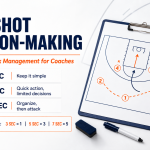
The Last Shot Decision Guide organizes these situations into three critical time windows:
1–3 seconds, 3–6 seconds, and 6–12 seconds.
That distinction is important because a good decision with 10 seconds remaining may be completely wrong with only two seconds on the clock.
The less time available, the more the offense must eliminate unnecessary decisions.
The Core Principle: Time Determines Complexity
One of the most important concepts in late-game basketball is that offensive complexity should decrease as the clock gets shorter.
With 10 seconds remaining, a team may have enough time to advance the ball, organize spacing, initiate an action and allow its best creator to read the defense.
With three seconds remaining, there is usually no time for that sequence.
The possession must become much more direct.
This creates three different offensive environments.
1–3 Seconds: Immediate Execution
When only one to three seconds remain, the priority is not running a complete offensive possession.
It is creating one immediate scoring opportunity.
There is little room for:
- multiple reversals,
- excessive dribbling,
- slow screening sequences,
- complicated reads,
- or secondary actions.
Players should know exactly what is coming before the ball becomes live.
In these situations, simplicity is an advantage.
The guide repeatedly emphasizes an inbounds pass only approach for several out-of-bounds situations. The idea is clear: the offense cannot waste the clock trying to develop a long sequence.
The first action must create the shot.
This can mean:
- a direct catch-and-shoot,
- a lob or rim opportunity,
- a quick screen-the-screener action,
- a decoy that frees the primary shooter,
- or a catch that immediately creates one attacking dribble.
The guide refers to a predetermined “FLY” action in several of these situations. The exact design of that action will depend on the team’s own playbook, but from a coaching perspective the important concept is that it is pre-called, fast and familiar.
The players should not be trying to solve the possession from scratch.
They should already know the solution.
3–6 Seconds: Quick Action, Limited Decisions
Three to six seconds creates an interesting middle ground.
There is enough time to do more than simply catch and shoot, but not enough time to run a normal half-court possession.
The guide recommends two major approaches depending on how possession begins:
Use a scripted out-of-bounds action, or
attack through a quick-break package.
For out-of-bounds situations, it also recommends keeping the sequence to approximately two or three passes maximum.
This is excellent late-game discipline.
Every additional pass consumes time and increases the possibility that the offense ends up with the wrong player holding the ball as the clock expires.
A three-to-six-second possession should therefore have a clearly defined progression:
First option → second option → immediate shot or attack.
Players must understand that they do not have enough time to keep searching for the perfect opportunity.
A good shot taken on time is often better than a theoretical great shot that never gets released.
6–12 Seconds: Organize, Then Attack
Six to twelve seconds provides significantly more freedom.
Now the team can push the ball, establish spacing and flow into its preferred late-game action.
The guide repeatedly emphasizes one coaching principle in this time range:
Get the ball into the hands of your best decision-maker.
That player does not necessarily have to be the team’s leading scorer.
The best late-game decision-maker is the player who can correctly read:
- switches,
- traps,
- help defense,
- defensive matchups,
- spacing,
- driving lanes,
- and the location of secondary shooters.
In some teams, that is the point guard.
In others, it may be a wing creator, a scoring guard or even a playmaking big.
The key is that the final possession should not accidentally end up in the hands of a player the defense wants making the decision.
The offense should actively create the desired matchup and decision-making environment.
Out-of-Bounds Situations
The location of the inbound changes the geometry of the possession.
The guide separates endline, sideline and baseline situations because each creates different passing angles and different defensive problems.
Endline Inbound
With only 1–3 seconds remaining, the recommendation is to immediately execute the team’s predetermined quick action.
With 3–6 seconds, the guide suggests moving into press-break spacing while limiting the possession to only a few passes.
This matters because defenses frequently extend pressure in late-clock situations.
Spacing the floor correctly allows the offense to receive the inbound cleanly without wasting valuable seconds fighting pressure in the backcourt.
With 6–12 seconds, the objective changes.
Advance the basketball and flow directly into the team’s last-shot action.
Do not treat the possession as two separate phases.
The transition from advancing the ball to attacking should be seamless.
Sideline Out-of-Bounds
A sideline inbound is one of the most valuable late-game situations because it allows teams to prepare highly specific actions.
With 1–3 seconds, the guide recommends the team’s dedicated sideline out-of-bounds set.
With 3–6 seconds, use the scripted SLOB action while limiting unnecessary ball movement.
With 6–12 seconds, the team can push the ball, organize spacing and then execute its final action.
From a coaching standpoint, every serious team should have several SLOB packages prepared:
- one for a three-point shot,
- one for a quick two,
- one designed for the best scorer,
- one counter against switching,
- and one option if the first action is denied.
Late-game execution becomes far easier when players recognize the situation instead of waiting for the coach to explain everything during the timeout.
Baseline Out-of-Bounds
The same timing logic applies to baseline situations.
With 1–3 seconds, use the dedicated baseline out-of-bounds action immediately.
With 3–6 seconds, execute the scripted baseline action with limited passing.
With 6–12 seconds, inbound, organize and flow directly into the planned final possession.
Baseline situations can be especially valuable because the defense must protect the rim while simultaneously defending screening actions away from the ball.
Screen-the-screener actions, slips, back screens and misdirection can all become dangerous.
But again, the clock determines how much complexity is possible.
After an Opponent Field Goal Attempt
Another important part of late-game coaching is deciding whether to stop the game or attack before the defense gets organized.
Opponent Makes the Shot
With only 1–3 seconds remaining, the guide recommends using a timeout and then executing the predetermined quick out-of-bounds action.
There simply is not enough time to improvise.
With 3–6 seconds, however, the recommendation changes:
Attack immediately with the quick-break package.
This can prevent the opponent from setting its preferred late-game defense.
With 6–12 seconds, the offense should push the basketball and move directly into the final action, ideally placing the ball in the hands of the best decision-maker.
The coaching lesson is important:
A timeout is not automatically the best late-game decision.
Sometimes attacking a disorganized defense is more valuable than giving both teams time to prepare.
Opponent Misses the Shot
A defensive rebound creates a different situation.
With only 1–3 seconds remaining, the guide recommends securing the rebound, using the timeout and executing the quick action.
With 3–6 seconds, attack using the quick-break package.
With 6–12 seconds, push the basketball and flow directly into the planned last-shot action.
The rebounder must understand the clock immediately.
There is no time to secure the rebound, look around and then decide what to do.
The decision must already be programmed through practice.
Opponent Free-Throw Situations
Free throws offer coaches something extremely valuable:
time to organize before the ball becomes live again.
That means players should already know what happens after both a make and a miss.
With 1–3 seconds after a made opponent free throw, the guide again calls for the predetermined quick action.
After a missed free throw, secure the rebound, use the timeout when appropriate and move into the prepared action.
With 3–6 seconds, the guide favors the quick-break package.
With 6–12 seconds, the offense should push the ball and transition directly into the last-shot action.
The major coaching mistake here is allowing players to wait until the rebound occurs before deciding what to do.
The plan should be communicated before the free throw is attempted.
Your Own Free Throw: A Special Late-Game Situation
The team’s own free throw introduces several tactical possibilities.
When only 1–3 seconds remain and the game situation requires another possession, the guide recommends considering an intentional miss and attacking the offensive rebound.
This is a specialized situation and players must understand the rules of the competition.
The phrase in the guide — “Know the rules” — is important.
Teams should practice intentional-miss situations rather than attempting them for the first time in an actual game.
With approximately 4–6 seconds available, the guide presents a different possibility:
Make the free throw and immediately organize the defensive response to the inbound.
The team may attempt to disrupt the inbound, create a turnover opportunity and use a timeout if possession is regained. If the ball cannot be recovered, the next decision may be to foul quickly depending on score, time and game context.
This is another reason why late-game coaching must cover more than offensive plays.
The possession after the free throw can determine the game just as much as the free throw itself.
Jump Ball Situations
Late-game jump balls are chaotic because neither team begins with guaranteed possession.
The guide therefore emphasizes anticipation.
Players must know:
- where the tap is likely to go,
- who is responsible for securing possession,
- whether a timeout should be called,
- what action follows possession,
- and what to do if the opponent wins the ball.
With shorter time available, securing possession and immediately transitioning into the proper out-of-bounds or timeout situation becomes the priority.
With 6–12 seconds, the team can push the ball and go directly into the last-shot action.
There should be no celebration after winning the tap.
Possession is only the beginning of the sequence.
The Dribble Limit: A Powerful Coaching Concept
One of the most useful details in the guide is the Dribble Limit Guide:
- 3 seconds — 1 dribble
- 5 seconds — 3 dribbles
- 7 seconds — 5 dribbles
These numbers should not be viewed as an absolute mathematical law.
They are better understood as a coaching constraint that teaches players how quickly late-game time disappears.
Players often believe they have more time than they actually do.
Three seconds can disappear during one catch, one hesitation and one unnecessary dribble.
By practicing with dribble restrictions, coaches teach players to play with greater urgency.
The goal is not simply to dribble faster.
The goal is to make the decision earlier.
Put the Ball in the Right Player’s Hands
One phrase appears repeatedly throughout the guide:
Put it in your best player’s hands.
More specifically, coaches should think about their best decision-maker.
Late-game basketball is usually defended differently than ordinary possessions.
Opponents may:
- switch every screen,
- trap the primary scorer,
- deny the first option,
- force the ball toward a weaker handler,
- top-lock shooters,
- or intentionally give up a particular matchup.
Because of this, the offense needs a player capable of reading the defense rather than simply following the original diagram.
A last-shot play should create an advantage.
The player must then recognize what advantage actually appears.
How Coaches Should Practice These Situations
Late-game offense cannot be developed only by drawing plays on a whiteboard.
It must be rehearsed under realistic constraints.
A useful practice structure is to create repeated game scenarios such as:
12 seconds — opponent scores — no timeout.
Players must immediately push and enter the last-shot action.
Then:
5 seconds — sideline inbound.
Players execute the scripted SLOB action.
Then:
2.4 seconds — baseline inbound.
One pass, one decision, one shot.
Then:
6 seconds — opponent misses a free throw.
Secure the rebound and attack immediately.
Then change the score.
Tie game.
Down one.
Down two.
Down three.
Each situation changes the type of shot the offense needs.
The objective is to create automatic recognition.
By the end of the season, players should not need the coach to explain every scenario.
They should see the clock and immediately understand the team’s late-game rules.
Build a Decision System, Not Just a Last-Shot Play
The biggest takeaway from late-game offense is that teams should not rely on one “magic” play.
They need a decision system.
That system should define:
- What happens after a made basket.
- What happens after a defensive rebound.
- What happens after a made or missed free throw.
- Which sideline and baseline actions are available.
- When the team uses a timeout.
- Who becomes the primary decision-maker.
- How many passes and dribbles are acceptable.
- What happens if the first option is denied.
- How the team attacks before the defense becomes organized.
- Which actions are used in each clock window.
When those rules are clear, players can execute faster because they spend less time thinking about what to do and more time reading how the defense reacts.
Final Coaching Takeaway
The final possession is rarely decided only by the final shot.
It is usually decided by everything that happens before it:
clock recognition, timeout management, spacing, inbound organization, transition decisions, player selection and decision speed.
With 1–3 seconds, simplify.
With 3–6 seconds, attack quickly and limit unnecessary actions.
With 6–12 seconds, organize the possession, create the desired matchup and put the basketball in the hands of the player you trust to make the final read.
Great late-game teams do not simply have good last-shot plays.
They have players who understand exactly what the clock allows them to do.
That is the difference between hoping to create a final shot and being prepared to create one.